

 +86-150-5857-3741+86-136-0679-8873
 carolzhang@hnhktech.com
+86-150-5857-3741+86-136-0679-8873carolzhang@hnhktech.com
carolzhang@hnhktech.com
+86-150-5857-3741+86-136-0679-8873carolzhang@hnhktech.com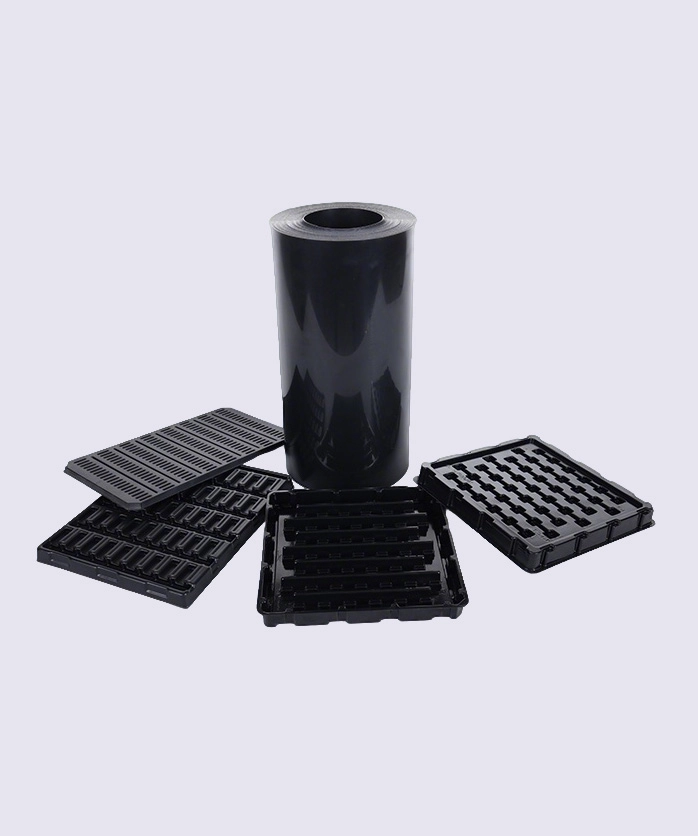
ABS plastic sheets are suitable for packaging various electronic components and industrial products.
1. Excellent thermoplastic properties
2. Long-lasting antistatic performance
3. Environmentally friendly and clean material
1. Packaging for electronic components
2. Packaging for industrial products
|
Item |
Conductive |
Antistatic |
Normal |
|
Density(±0.02) |
1.06g/cm3 |
1.06g/cm3 |
1.06g/cm3 |
|
Thickness(±0.02) |
0.3mm-2mm |
0.3mm-2.0mm |
0.3mm-2.0mm |
|
S.R.(Ω) |
104-8 |
109-11 |
≥1012 |
|
Max.Width (±1.0mm) |
640mm |
640mm |
640mm |
|
Max. Weight(±0.5KG) |
250KG |
250KG |
250KG |
ABS plastic sheets are flat, rigid thermoplastic panels made from Acrylonitrile Butadiene Styrene (ABS) — a widely used engineering-grade polymer formed by combining three distinct monomers:
The combination of these three components gives ABS its uniquely balanced profile: it is simultaneously tough, rigid, and easy to thermoform or machine. Unlike brittle plastics that crack under stress, or soft plastics that deform under load, ABS occupies a high-performance middle ground that makes it the material of choice across electronics packaging, industrial fabrication, automotive interiors, and consumer goods.
At Haining Hongkai Technology Co., Ltd., ABS plastic sheets are produced under strict quality controls on advanced extrusion lines, with each roll or sheet inspected for dimensional accuracy, surface uniformity, and electrical performance. The company holds ISO 9001 and ISO 14001 certifications, and products have passed SGS certification — reflecting the rigorous standards applied throughout the manufacturing process.
Understanding why ABS plastic performs so reliably requires a brief look at its polymer structure.
ABS is a terpolymer, meaning it is built from three chemically distinct building blocks polymerized together. The butadiene rubber phase is dispersed as small particles throughout a continuous matrix of styrene-acrylonitrile (SAN) copolymer. When a stress or impact is applied to an ABS sheet, energy is absorbed by these rubber particles before it can propagate as a crack — a mechanism called rubber toughening.
The proportions of A, B, and S can be adjusted during manufacturing to shift the balance of these properties. Higher butadiene content increases toughness at the cost of some hardness; higher acrylonitrile content improves chemical resistance and heat deflection; higher styrene content increases stiffness and surface gloss. This tunability is one of the key reasons ABS remains relevant across so many industries.
Hongkai's ABS plastic sheets are manufactured in three electrical grades, each tailored to different industrial requirements:
Conductive ABS sheets are formulated with carbon black or conductive fiber filaments dispersed uniformly through the polymer matrix. They are designed for applications where static charge must be actively dissipated to protect sensitive electronics.
Antistatic ABS sheets use a permanently integrated antistatic agent rather than a surface coating, which means the property does not wear off over time. This is critically important for long-term packaging reliability.
Standard ABS sheets are non-conductive and optimized for general-purpose industrial and mechanical applications where electrical properties are not the primary requirement.
The table below summarizes the key parameters for all three grades of ABS plastic sheets available from Haining Hongkai Technology:
| Parameter | Conductive | Antistatic | Normal |
| Density (±0.02) | 1.06 g/cm³ | 1.06 g/cm³ | 1.06 g/cm³ |
| Thickness Range (±0.02mm) | 0.3 mm – 2.0 mm | 0.3 mm – 2.0 mm | 0.3 mm – 2.0 mm |
| Surface Resistivity (Ω) | 10⁴ – 10⁸ | 10⁹ – 10¹¹ | ≥ 10¹² |
| Maximum Width (±1.0 mm) | 640 mm | 640 mm | 640 mm |
| Maximum Roll Weight (±0.5 kg) | 250 kg | 250 kg | 250 kg |
| Electrical Classification | Conductive | Antistatic | Insulating |
| Property | Typical Value / Description |
| Tensile Strength | 40 – 50 MPa |
| Flexural Modulus | 2,100 – 2,400 MPa |
| Izod Impact Strength (notched) | 150 – 300 J/m |
| Heat Deflection Temperature | 70 – 100°C (depending on grade) |
| Vicat Softening Point | Approximately 88 – 103°C |
| Coefficient of Thermal Expansion | ~90 × 10⁻⁶ /°C |
| Flammability | HB rating (UL94) for standard; V-0 available in flame-retardant grades |
| Water Absorption (24h) | 0.2 – 0.4% |
| Color Availability | Black (standard); custom colors on request |
| Surface Finish | Smooth / matte; customizable texture |
Note: Values above represent industry-standard ranges for ABS materials. Exact values for Hongkai products may vary by formulation and should be confirmed at the time of order. Contact us at carolzhang@hnhktech.com for certified test reports.
ABS is a true thermoplastic — it softens when heated and solidifies when cooled, without any chemical change.
Unlike some plastics that rely on surface-applied antistatic coatings, Hongkai's antistatic ABS sheets incorporate the antistatic agent throughout the bulk material.
This is particularly valuable in electronics assembly environments where packaging integrity must be maintained through multiple handling cycles.
This is the primary application of conductive and antistatic ABS sheets. The electronics supply chain requires packaging that protects components from both physical damage and electrostatic discharge (ESD).
The ability to specify exact surface resistivity values (conductive vs. antistatic grade) allows packaging engineers to match the sheet grade to the sensitivity rating of the component being protected.
Standard and antistatic ABS sheets are widely used in industrial packaging where mechanical robustness is the priority:
One of the most commercially valuable aspects of ABS plastic sheets is their versatility in downstream processing.
ABS is among the most thermoform-friendly engineering plastics available.
Understanding how ABS compares to alternative materials helps specifiers make informed decisions. Haining Hongkai also manufactures APET plastic sheets and HIPS plastic sheets, giving customers flexibility across a range of performance requirements.
| Property | ABS | APET | HIPS |
| Impact Resistance | Excellent | Moderate | Good |
| Clarity / Transparency | Opaque (standard) | Clear / transparent | Opaque or translucent |
| Thermoformability | Excellent | Excellent | Good |
| Stiffness | High | High | Moderate |
| Chemical Resistance | Good | Moderate | Fair |
| Food Contact Suitability | Limited (grade-dependent) | Good | Limited |
| ESD / Antistatic Grades | Yes | Limited | Limited |
| Surface for Printing | Excellent | Good | Good |
| Typical Applications | Electronics trays, industrial packaging | Food trays, display, medical | Disposable cups, trays, models |
| Recyclability | Yes | Yes | Yes |
For electronics and industrial packaging where ESD protection, mechanical durability, and long service life matter most, ABS plastic sheets offer a compelling combination of properties unavailable in HIPS or APET alone. For applications where optical clarity is required, APET plastic from Hongkai is the preferred solution. For cost-sensitive disposable packaging, HIPS sheets provide an economical alternative.
All three ABS sheet grades (conductive, antistatic, normal) are manufactured on the same ISO-certified production lines, with individual batch testing to verify dimensional tolerances and electrical properties before shipment.
For customers requiring documentation for regulatory compliance or customer qualification purposes, test reports and certificates of conformance are available. Contact carolzhang@hnhktech.com to request materials.
Haining Hongkai Technology Co., Ltd. operates from its facility in the Jianshan New District, Haining City — a strategically located industrial zone in the Yangtze River Delta Economic Zone, providing efficient access to Shanghai and Hangzhou airports and major sea ports.
This vertical integration — from raw material supply through compounding to finished sheet — gives Hongkai direct control over the conductivity-modifying additives that determine the electrical performance of antistatic and conductive ABS grades.
| Parameter | Available Range |
| Thickness | 0.3 mm – 2.0 mm (tolerance ±0.02 mm) |
| Width | Up to 640 mm (tolerance ±1.0 mm) |
| Roll Weight | Up to 250 kg per roll (tolerance ±0.5 kg) |
| Electrical Grade | Conductive / Antistatic / Normal |
| Color | Black (standard); custom available |
| Surface | Smooth / textured (on request) |
Custom specifications — including non-standard thicknesses, special widths, or particular functional additives — can be discussed with the Hongkai technical team. With over 20 years of formulation experience and in-house compounding capability, the team is well-positioned to develop tailored solutions for demanding applications.
To request a quotation, visit the Contact page or email carolzhang@hnhktech.com. Phone enquiries are also welcome at +86-15058573741.
Conductive ABS has a surface resistivity of 10⁴ – 10⁸ Ω and actively dissipates charge to ground very quickly. Antistatic ABS has a resistivity of 10⁹ – 10¹¹ Ω and prevents charge build-up, but at a slower, more controlled rate. The choice depends on the sensitivity of the components being packaged and the specific ESD standard (such as ANSI/ESD S20.20 or IEC 61340) that the packaging system must meet.
No. Hongkai's antistatic ABS sheets use a permanently integrated antistatic agent dispersed throughout the material, rather than a surface coating. This means the performance is maintained throughout the product's service life, regardless of surface abrasion or handling.
Yes. ABS is one of the most straightforward engineering plastics to thermoform. It performs well on both single-station and rotary thermoforming equipment. Material should be pre-dried (80°C for 2–4 hours) to eliminate moisture-related surface defects prior to forming.
Standard ABS is generally not recommended for direct food contact without specific food-grade formulation and regulatory certification. For food packaging applications, Hongkai's APET plastic sheets are the preferred choice, as APET has broad food contact approval in many jurisdictions.
Please contact the Hongkai team at carolzhang@hnhktech.com or via the quotation form for current minimum order information and lead times.
ABS generally provides superior impact resistance, better long-term dimensional stability, and is more suitable for precision thermoformed trays where tight tolerances are required. HIPS sheets are lower in cost and well-suited for less demanding packaging applications. For high-value electronics components, ABS — particularly in antistatic or conductive grades — is the industry standard.
Share Your Contact Information For Personalized Service.