



Acrylonitrile Butadiene Styrene (ABS) plastic sheet is one of the most widely specified thermoplastic materials in global manufacturing. This guide examines its chemistry, mechanical properties, grades, processing methods, and real-world applications — drawing on the product expertise of Haining Hongkai Technology Co., Ltd., a leading China-based factory and wholesale supplier.
1. What Is ABS Plastic Sheet?
ABS plastic sheet is a rigid thermoplastic panel produced from the terpolymer Acrylonitrile Butadiene Styrene. Each monomer contributes a distinct set of performance characteristics to the final material:
- Acrylonitrile imparts chemical resistance, surface hardness, and thermal stability.
- Butadiene contributes toughness, low-temperature impact strength, and ductility.
- Styrene delivers rigidity, gloss, and processability.
This three-phase polymer structure gives ABS sheets an outstanding balance of properties that neither component alone could achieve, making them a preferred engineering material across dozens of industries.
2. Key Mechanical and Physical Properties
Understanding the core properties of ABS plastic sheet helps engineers select the correct grade and thickness for their application. The table below summarises the most critical parameters.
| Property | Typical Value | Test Standard |
|---|---|---|
| Density | 1.04 – 1.06 g/cm³ | ISO 1183 |
| Tensile Strength | 38 – 50 MPa | ISO 527 |
| Flexural Modulus | 1,800 – 2,500 MPa | ISO 178 |
| Izod Impact (notched) | 15 – 25 kJ/m² | ISO 180 |
| Hardness (Rockwell R) | 100 – 115 | ISO 2039-2 |
| Heat Deflection Temperature | 80 – 100 °C | ISO 75-2 (1.8 MPa) |
| Coefficient of Thermal Expansion | 72 – 90 × 10⁻⁶ /°C | ISO 11359 |
| Water Absorption (24 h) | 0.2 – 0.4% | ISO 62 |
| Flammability (UL 94) | HB (standard) / V-0 (FR grade) | UL 94 |
3. ABS Sheet Grades: Conductive, Antistatic, and Standard
Not all ABS sheets are equal. Haining Hongkai's ABS plastic sheet range covers three primary grades, each engineered for a specific electrostatic management requirement — critical in electronics manufacturing and precision industrial packaging.
| Parameter | Conductive | Antistatic | Standard (Normal) |
|---|---|---|---|
| Density (±0.02) | 1.06 g/cm³ | 1.06 g/cm³ | 1.06 g/cm³ |
| Thickness Range (±0.02 mm) | 0.3 mm – 2.0 mm | 0.3 mm – 2.0 mm | 0.3 mm – 2.0 mm |
| Surface Resistivity (Ω) | 10⁴ – 10⁸ | 10⁹ – 10¹¹ | ≥ 10¹² |
| Maximum Width (±1.0 mm) | 640 mm | 640 mm | 640 mm |
| Max. Roll Weight (±0.5 kg) | 250 kg | 250 kg | 250 kg |
| Primary Use Case | ESD-sensitive component trays | Electronic device packaging | General industrial & consumer |
The conductive grade (surface resistivity 10⁴–10⁸ Ω) is specified wherever electrostatic discharge could damage sensitive microelectronics. The antistatic grade (10⁹–10¹¹ Ω) provides a cost-effective electrostatic control solution for general electronic packaging, while the standard grade serves structural and aesthetic applications across virtually every other sector.
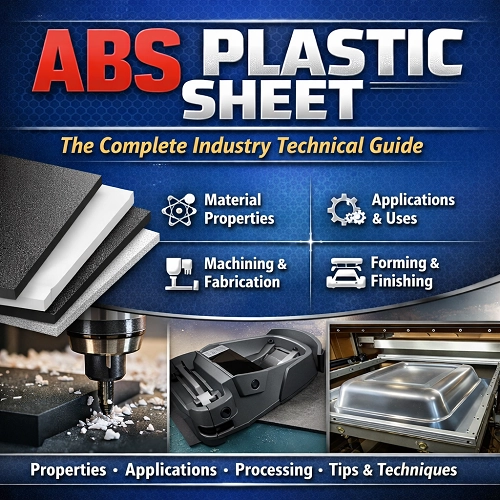
4. Processing and Fabrication Techniques
ABS plastic sheet's processing versatility is one of its most commercially significant attributes. Manufacturers can transform it using a wide range of standard industrial methods.
4.1 Thermoforming & Vacuum Forming
ABS sheet softens predictably at temperatures between 150 °C and 180 °C, allowing it to be vacuum-formed or pressure-formed over complex three-dimensional tooling. Low forming pressure requirements reduce tooling costs, and the material retains sharp detail and consistent wall thickness throughout the formed part.
4.2 CNC Machining
Unlike many engineering polymers, ABS cuts cleanly with standard high-speed steel or carbide tooling. Drilling, routing, milling, and sawing all produce smooth edges with minimal burring, reducing secondary finishing time and cost.
4.3 Adhesive Bonding & Solvent Welding
ABS bonds readily with methyl ethyl ketone (MEK), acetone-based solvent cements, and structural epoxy adhesives. Solvent welding dissolves the surface polymer chains and creates a molecular bond that can approach the strength of the parent material.
4.4 Printing & Surface Decoration
The smooth, high-gloss surface of standard ABS sheet accepts screen printing, pad printing, UV inkjet, and hot-stamping foils without pre-treatment. Matte and textured finishes are also available for applications where glare reduction or improved grip is required.
| Process | Typical Temperature / Parameter | Key Advantage |
|---|---|---|
| Vacuum / Pressure Forming | 150 – 180 °C | Complex 3-D geometry at low tooling cost |
| CNC Routing / Milling | Standard carbide tooling | Clean edges, tight dimensional tolerances |
| Solvent Welding | Room temperature (MEK / acetone) | Near-parent-strength molecular bond |
| Structural Epoxy Bonding | Room temperature cure | Bond to dissimilar substrates (metal, glass) |
| Screen / Pad Printing | UV or solvent inks | High-resolution graphics without pre-treatment |
| Hot-Stamp Foiling | 80 – 120 °C die temperature | Metallic decorative finish |
5. Industry Applications
ABS plastic sheets are trusted by manufacturers in a broad spectrum of end-use markets. The combination of mechanical toughness, surface quality, and fabrication ease places ABS in a class of materials that few alternatives can match at comparable cost.
Automotive
Dashboard substrates, door-panel inserts, pillar trims, and instrument cluster surrounds are routinely produced from thermoformed ABS sheet. The material's dimensional stability under cyclic heat exposure and its ability to accept Class-A painted finishes make it a standard automotive interior material worldwide.
Electronics & Domestic Appliances
Television bezels, computer monitor housings, printer enclosures, and white-goods panels are among the most common consumer electronics applications. Conductive and antistatic grades are essential for component-level packaging trays that protect microelectronics during shipping and storage.
Industrial Packaging
Vacuum-formed ABS trays provide rigid, reusable protection for precision components during transit. The material's resistance to diluted acids and alkalis extends the service life of industrial containers used in chemical processing environments.
Construction & Signage
Decorative wall cladding, display-board substrates, and retail signage benefit from ABS sheet's combination of rigidity, light weight, and paintable surface. Flame-retardant grades meeting UL 94 V-0 are specified in interior architectural applications governed by building codes.
Medical Devices
Instrument housings, diagnostic equipment panels, and protective enclosures for laboratory devices leverage ABS sheet's cleanroom-compatible surface and ease of disinfection with hospital-grade surface cleaners.
Toys & Consumer Products
LEGO bricks — arguably the world's most recognizable ABS product — demonstrate the material's dimensional precision and fatigue resistance over millions of assembly cycles. These same attributes translate across children's toys and consumer electronics accessories.
| Industry | Typical ABS Sheet Application | Preferred Grade |
|---|---|---|
| Automotive | Dashboard panels, door trims, pillar covers | Standard / High-heat |
| Electronics | Device housings, monitor bezels | Standard / Flame-retardant |
| Electronics Packaging | ESD component trays, carrier tapes | Conductive / Antistatic |
| Industrial Packaging | Component trays, shipping containers | Standard / Antistatic |
| Construction | Wall panels, signage, decorative surfaces | Standard / FR grade |
| Medical | Device enclosures, instrument panels | Standard (low-outgassing) |
| Toys & Consumer | Structural casings, play components | Standard / High-impact |
6. ABS vs. Competing Thermoplastic Sheet Materials
Specifying the right material requires comparing ABS against its most common alternatives. The table below positions ABS relative to HIPS (High Impact Polystyrene) and APET (Amorphous Polyethylene Terephthalate) — the two materials most frequently evaluated alongside ABS for sheet applications.
| Attribute | ABS Sheet | HIPS Sheet | APET Sheet |
|---|---|---|---|
| Impact Resistance | Excellent | Good | Good |
| Surface Gloss | High | Medium | Very High |
| Chemical Resistance | Good | Moderate | Excellent |
| Thermoformability | Excellent | Excellent | Good |
| Food-Contact Compliance | Limited | Limited | Yes (food-safe grades) |
| Cost Index (relative) | Medium–High | Low–Medium | Medium |
| Typical Application | Structural / Electronic | Disposable packaging | Food & cosmetic trays |
For food and cosmetic packaging where direct food contact is required, APET plastic film is the recommended alternative. For cost-sensitive, single-use retail packaging, HIPS sheet delivers good performance at a lower material cost. ABS remains the specification of choice wherever structural integrity, multi-cycle durability, or ESD management is the primary design driver.
7. Quality Assurance & Certifications
Industrial buyers increasingly require documented quality assurance as a baseline supplier qualification criterion. Haining Hongkai Technology holds:
- ISO 9001 — Quality Management Systems certification confirming process control and product consistency.
- ISO 14001 — Environmental Management Systems certification demonstrating commitment to responsible manufacturing.
- SGS Certification — Independent third-party product verification for safety and regulatory compliance.
Each production batch undergoes dimensional inspection (thickness, width, roll weight) and surface quality assessment before release, ensuring that the tolerances listed in the product specification — thickness ±0.02 mm, width ±1.0 mm, weight ±0.5 kg — are consistently met across the facility's 700-tonne monthly output.
8. Sourcing ABS Plastic Sheet: What to Evaluate
When qualifying an ABS sheet supplier for a long-term procurement relationship, the following criteria should be assessed:
| Evaluation Criterion | Why It Matters |
|---|---|
| Dimensional tolerances (thickness, width) | Tight tolerances reduce downstream rejection rates in forming and machining |
| Available grades (conductive / antistatic / standard) | Single-supplier sourcing simplifies procurement and logistics |
| Quality certifications (ISO, SGS) | Provides auditable evidence of process control and product safety |
| Monthly production capacity | Ensures supply continuity for large or growing volume requirements |
| Customisation capability | Colour, finish, thickness, and functional property flexibility reduces stock inventory |
| Factory-direct pricing | Eliminates distributor margin, improving landed cost competitiveness |
| Minimum Order Quantity (MOQ) | Flexible MOQ reduces cash-flow risk during product development phases |
With over 20 years of R&D and manufacturing experience, Haining Hongkai Technology addresses each of these criteria through factory-direct supply, a comprehensive plastic sheet and roll product catalogue, and dedicated customer support.
Request a Custom ABS Plastic Sheet Quote
Whether you need standard conductive, antistatic, or normal-grade ABS sheet in custom thicknesses and widths, or are exploring complementary materials such as APET or HIPS, Haining Hongkai Technology offers factory-direct wholesale pricing, flexible MOQ, and ISO-certified quality assurance.
Contact Haining Hongkai Technology →Email: carolzhang@hnhktech.com | Tel: +86-150-5857-3741 | +86-136-0679-8873
References & Further Reading
- ABS Plastic Sheet — China Factory & Wholesale Supplier (Haining Hongkai Technology)
- ABS Plastic Sheets — Product Technical Specifications
- APET Plastic Film — Haining Hongkai Technology Product Range
- HIPS Plastic Sheet — Haining Hongkai Technology Product Range
- About Haining Hongkai Technology Co., Ltd. — Company History & Certifications
- Industry News — Haining Hongkai Technology
- Full Product Catalogue — Plastic Rolls & Sheets